

What I Found When I Audited One of Instagram's Biggest Accounts | Jay Shetty
THE 5PM CLUB — ISSUE #1

Hey, welcome back to the “State of Social!” Well kinda… I changed the name.
It’s been a while. The last issue went out in 2024 and a lot has changed since then. New name, new focus, and a much clearer sense of what this publication is actually for.
Over the last few years I’ve worked with solopreneurs, business owners, and some genuinely impressive entrepreneurs. The same questions keep coming up on calls. What should I be posting? How do I get clients? How do I even know what’s working? And with AI moving as fast as it is right now people don’t know where to look or what to trust.
So that’s what The 5PM Club is built around. Cutting through the noise. Breaking down what’s actually working in marketing, social media, and business growth for people building something on the side. Expect profile audits, tool breakdowns, tactics I’m testing myself, and honest takes on what’s worth your time and what isn’t.
For the last couple of years I've been writing in the mindset space over at Unrealized Purpose where we've built a subscriber base of over 1,800 readers. This is my first marketing focused publication so if you have feedback, topics you want me to dig into, or areas where you'd like me to go deeper, let me know. I'm building this for you.
Let’s get into it.
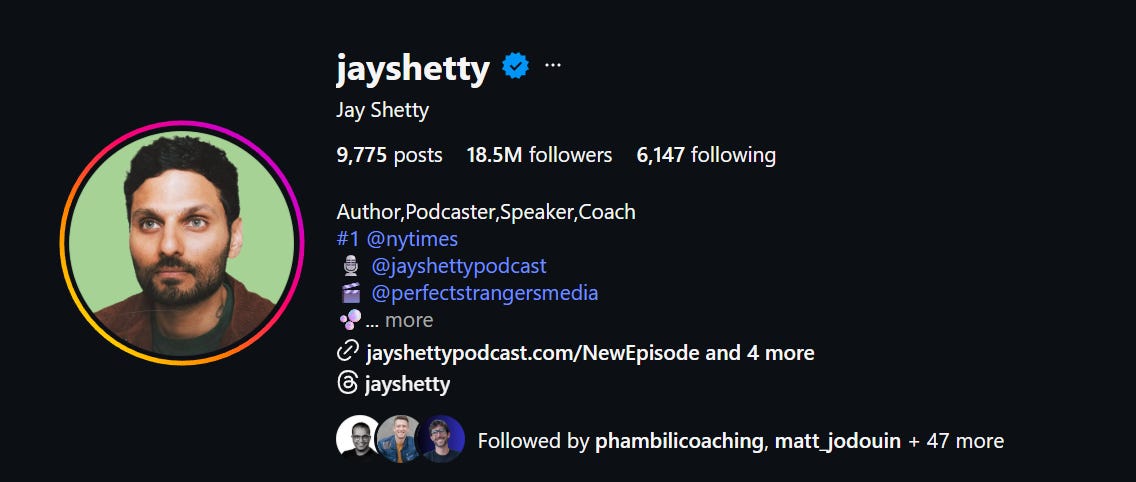
Most people look at Jay Shetty’s Instagram and think the same thing.
18.5 million followers. Must be nice.
Then they go back to posting and wondering why nothing is working.
Here’s the thing. Shetty didn’t build that account by getting lucky. He built a system. And buried inside that system are lessons that apply whether you have 18 million followers or 180.
I spent time breaking down his profile this week. This is what I found.
His Instagram is multifaceted.
It’s a content account built to drive awareness. And that awareness gives him leverage that most people can only dream about.
His bio tells you everything. NYT bestseller. Podcast host. Media company. Netflix deal. When a celebrity’s team is deciding whether to appear on his show the first thing they do is look him up. What they find is 18.5 million reasons to say yes.
That’s leverage. And it didn’t happen by accident.
You’re not at 18.5 million. Neither am I. But the principle applies at every level. Whatever platform you’re building on right now, Instagram, LinkedIn, Substack, it’s your most visible proof of credibility before it’s anything else. Build it like it matters because eventually it will open doors or close them.
Every post has a job. Not every post has the same job.
This is where most people get it wrong.
They treat every post like it needs to do everything. Go viral, drive followers, generate leads, and close sales all at once. So they either attach a pitch to everything or they add nothing and hope for the best.
Shetty’s feed does neither. It does something smarter.
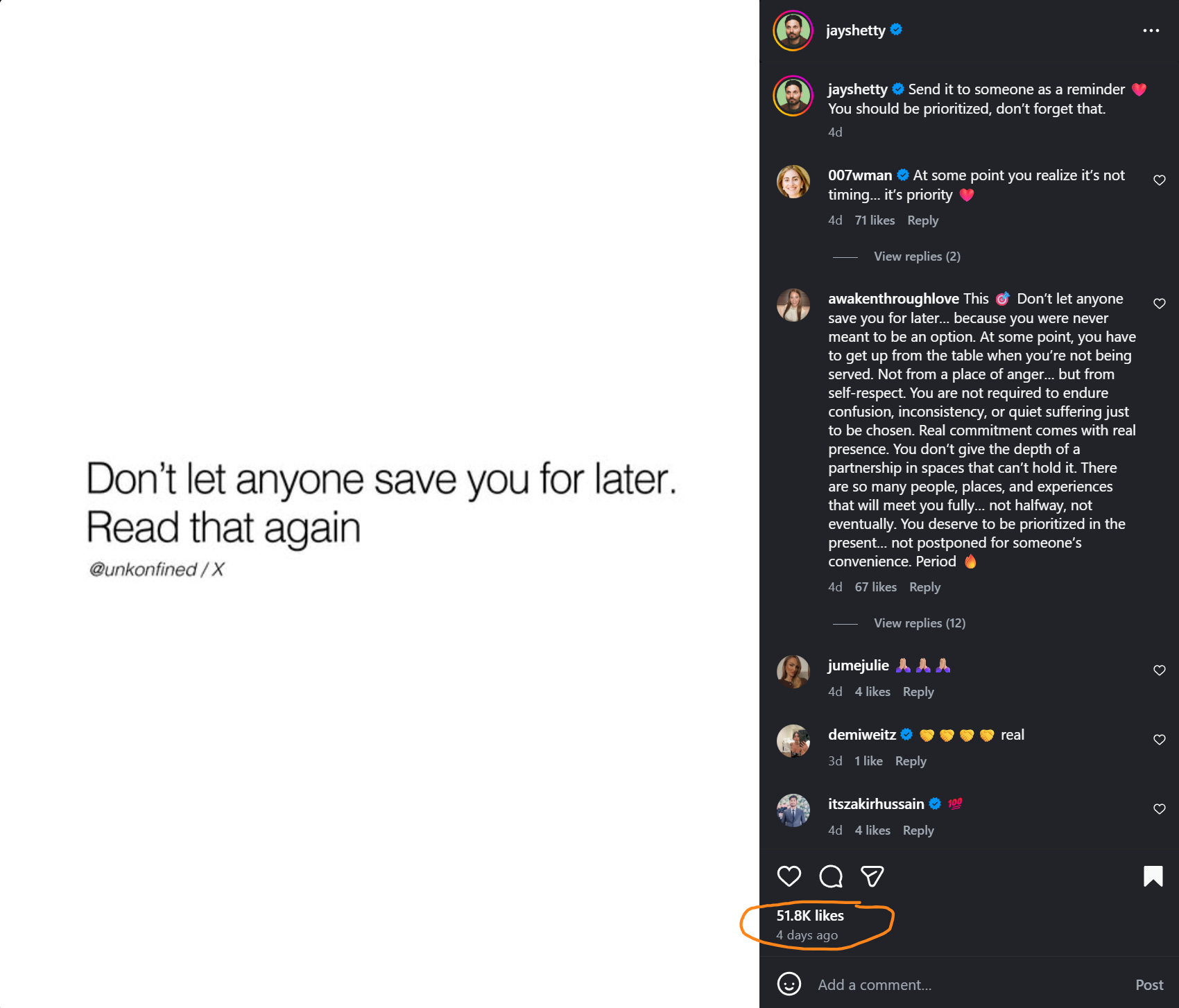
Some posts build awareness. His daily quote graphics, white background, simple text, pull 40,000 to 70,000 likes consistently. They’re not his highest performing content. They’re not supposed to be. Their job is to show up in the feed every single day and keep him visible.
And here’s the part most people miss. His profile picture shows up next to every single one of those posts. That’s a branded impression every time someone scrolls past whether they stop or not. The content doesn’t need to sell because the repeated exposure does the selling passively over time.

Some posts go viral. His aerial footage Reels, overhead crowd shots with floating text showing what each anonymous person might be quietly going through, have generated 1.8 and 2 million likes per post. These aren’t about Jay Shetty at all. They’re about you. Your invisible experience reflected back at you. That’s why they work.
Some posts drive action. His podcast clips don’t need to go viral. Their job is simply to remind his audience that a show exists and give them a reason to go listen.
The mix is intentional. The variety is what makes the whole thing feel human instead of like a marketing machine.
Now here’s where most people lose the plot entirely.
Your content should relate to your business. Shetty posts motivational quotes because transformation is his brand. Every quote reinforces who he is without ever pitching anything. He could easily slip a sales message into those posts. He doesn’t. He lets them stand on their own.
Before you create anything ask yourself two questions.
How does this serve my viewer?
How does it connect them to my business?
If you can’t answer both, stop. Rework it or scrap it.
Content that only serves the viewer builds goodwill but no business. Content that only serves your business gets ignored. You need both every time. And if you’re building a motivational brand you shouldn’t be posting random memes. Stay in your lane. Be consistent about what you stand for.
The feed is the top of the funnel. The money lives further down.

Think of Instagram as a marketing funnel. Awareness at the top. Conversion at the bottom.
A post drives awareness. Your caption drives consideration. It adds context, builds curiosity, gives someone a reason to care.
A CTA like “comment YES and I’ll send it to you” is designed to move someone toward conversion.
And the conversion itself? That mostly happens in the DMs. Not in the feed.
Shetty rarely pitches directly in his posts because the post isn’t where the relationship closes. The post gets people into the funnel. Everything downstream does the rest. His bio links point to his podcast, his email list, and his media company. Instagram fills the top. Those platforms do the converting.
Most solopreneurs treat every post like it needs to close a deal. That’s not how this works. Your job in the feed is to earn enough trust that someone takes one small next step. That’s it. Build the trust first. Everything else follows.
The “Comment YES” mechanic isn’t just about engagement.
You’ve seen it on his posts. “Comment YES if this resonates 👇”
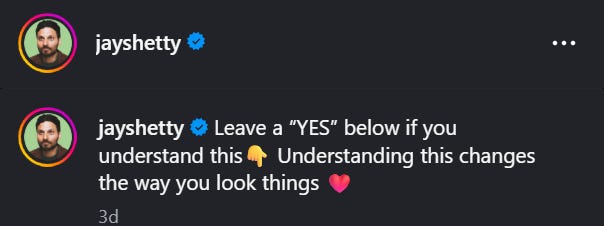
It looks simple. It’s actually working on two levels simultaneously.
First it’s low friction participation. Instagram is a quick hit platform. Nobody wants to write a paragraph in the comments. But anyone who feels something can type YES. Lower the barrier to engagement and more people participate. More participation signals to the algorithm that the post has momentum. The algorithm responds by pushing it further.
Second it makes people feel like they belong. He’s not asking for their opinion. He’s inviting them to declare something about themselves. That’s a different experience entirely. It builds a sense of community without requiring much from anyone.
For some posts he takes it further. Comment a trigger word and an automation tool called ManyChat sends a direct link to the episode straight to your DMs. No searching, no friction, no hoping you remember to look it up later. The link arrives immediately. We’ll dig into how that tool works in a future issue. It’s worth its own breakdown.
Not every post uses a CTA. His output is high enough that he can afford to blend it all together. Some posts invite a comment. Some send you a link. Some just exist to add value and keep the feed alive. The mix is what keeps it from feeling like a machine.
A word on curation and credit.
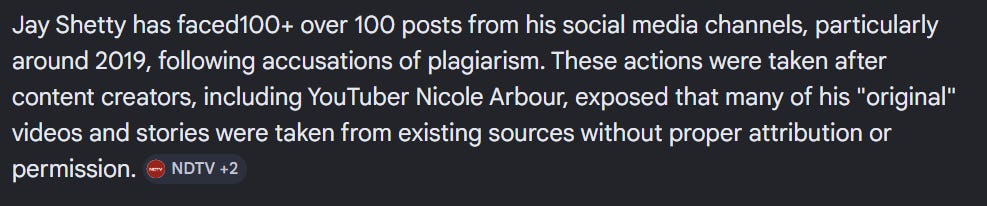
Part of Shetty’s early rise came from repurposing content from smaller creators. In 2019 he was publicly called out for it. He deleted over 100 videos and added credits retroactively.
I’ll be straight with you. I did something similar when I was starting out. I saw something working, I borrowed it too closely, and I got called out and blocked. It wasn’t a good feeling and it wasn’t a good look.
Here’s what I learned from it. If you see something you love, a format, an idea, a quote, you can use it. Repackage it, add your own perspective, and credit the source. Say where it came from. If it’s a quote name the person. If a video inspired you say so. People respect transparency. And if the original creator notices they often appreciate it.
There’s no shame in being influenced. There’s a lot of shame in pretending you weren’t.
What you can actually do with this starting today.
You don’t need 18 million followers to apply any of this. Here’s where to start.
Audit your profile like it’s your first impression. Because it is.
Does it clearly say who you are, who you help, and where to go next?
If someone landed on your page cold would they know what you do in five seconds? If the answer is no that’s your first fix.
Give every post a job before you create it. Awareness, consideration, or conversion. One job per post. And before you hit publish ask yourself the two questions.
Does this serve my viewer?
Does this connect them to my business? If you can’t answer both it’s not ready.
Try one low friction CTA this week. Try “comment YES if you’ve felt this.” Watch what happens to your engagement. Small shift, real difference.
Build something you own downstream. A newsletter, an email list, a community. Somewhere the audience lives that you control. Social platforms change their rules constantly. Your list doesn’t answer to an algorithm.
Shetty built something most people will never have. But the principles underneath it aren’t exclusive to someone with millions of followers.
They’re available to anyone willing to show up consistently, create with intention, and build trust before asking for anything in return.
That’s what The 5PM Club is about. Every week we break down what’s actually working so you can apply it to what you’re building after 5PM.
See you in the next one.
- Isaac
love this breakdown, Isaac
learned lots of useful stuff here
thank you